
How to Use Email Marketing for Business: 8 Practical Steps for 2026

Short answer: To use email marketing for business, set a clear goal, choose an email platform, build a permission-based list, segment your subscribers, set up a few core automated emails (welcome, abandoned cart, follow-up), send useful campaigns on a regular schedule, and track clicks, conversions and revenue to improve every month. Start small, stay consistent and focus on relevance, because a small engaged list beats a large inactive one.
Many business owners know they should be using email but are not sure where to begin. Should you send a newsletter, run promotions, or automate everything? The good news is that you do not need a big budget or a large team. You need a clear plan, a list of people who want to hear from you and the discipline to send helpful messages regularly.
This guide explains why email works for business, the main types of emails to send, eight practical steps to get started, the tools to consider, the metrics to track and what to keep in mind if you operate in Dubai. It is written by Slicky Media, a digital marketing agency in Dubai that uses email, search, paid ads and social media to help businesses grow.
Why Use Email Marketing for Business?
Email is one of the few marketing channels where you own the audience. Social platforms change their algorithms and ad prices rise, but your email list belongs to you. You can reach people directly, speak to them by name and send the right message at the right moment.
Email is also valued across the industry. Industry research consistently ranks it among the highest return channels in digital marketing, and as we explain in our guide on whether email marketing is in high demand, companies keep investing in the skills and tools behind it.
For most businesses, email helps in four ways:
Win new customers: nurture leads until they are ready to buy.
Increase repeat sales: bring past customers back with offers and reminders.
Build trust: share useful tips, news and updates that keep your brand in mind.
Save money: reuse the traffic you already paid for by turning visitors into subscribers.
Types of Business Emails You Can Send
You do not need to send every type on day one. Begin with two or three and add more as your list grows.
Email type | Purpose | Best for |
Welcome email | Introduce your brand and set expectations | Every business |
Newsletter | Share tips, news and updates regularly | Services, B2B, education |
Promotional email | Announce offers, launches and events | Ecommerce, hospitality, retail |
Abandoned cart email | Remind shoppers about items they left behind | Ecommerce |
Lead nurture series | Educate prospects over several emails before they buy | Real estate, healthcare, B2B |
Re-engagement email | Win back subscribers who stopped opening | Any business with an older list |
Transactional email | Confirm orders, bookings and appointments | Ecommerce, clinics, services |
Review or feedback request | Collect testimonials and improve service | Local and service businesses |
8 Steps to Use Email Marketing for Business
1. Set a clear goal
Every email program needs a purpose. Decide what you want email to do in the next three to six months. Typical goals include generating more enquiries, increasing repeat purchases, filling appointment slots, promoting events or keeping past customers informed. A clear goal tells you which emails to write and which numbers to watch.
Make the goal measurable. Instead of "get more from email," aim for something like "generate 20 extra enquiries a month from email" or "increase repeat orders from existing customers."
2. Choose an email marketing platform
Avoid sending marketing emails from a regular inbox. A proper platform manages subscribers, handles unsubscribes, protects deliverability and shows you results. Popular options include Mailchimp, Brevo, ActiveCampaign, Klaviyo for ecommerce and HubSpot for businesses that want email connected to a CRM. Most offer free plans or trials, so you can test one before you commit.
Choose based on your size and needs: ease of use, automation features, integrations with your website or store, and price as your list grows.

3. Build a permission-based email list
Your list is the foundation of everything. Build it with people who have chosen to hear from you. The main sources are:
Website sign-up forms: place them in your header, footer, blog posts and checkout page.
Organic search: helpful articles that rank in Google bring in readers who can join your list through a content upgrade or newsletter. A good SEO service helps you attract these visitors month after month.
Paid traffic: ads can send targeted visitors to a sign-up page. Professional PPC management and Google Ads management help you do this without wasting budget.
Social media: regular posts that invite people to subscribe, as we describe in our guide on what social media management does.
Lead magnets: a checklist, guide, template or discount that people receive in exchange for their email address.
In-person and customer touchpoints: event sign-ups, booking forms and point-of-sale requests, always with clear consent.
Never buy email lists. They damage your sender reputation, break consent rules and rarely convert.
4. Segment your subscribers
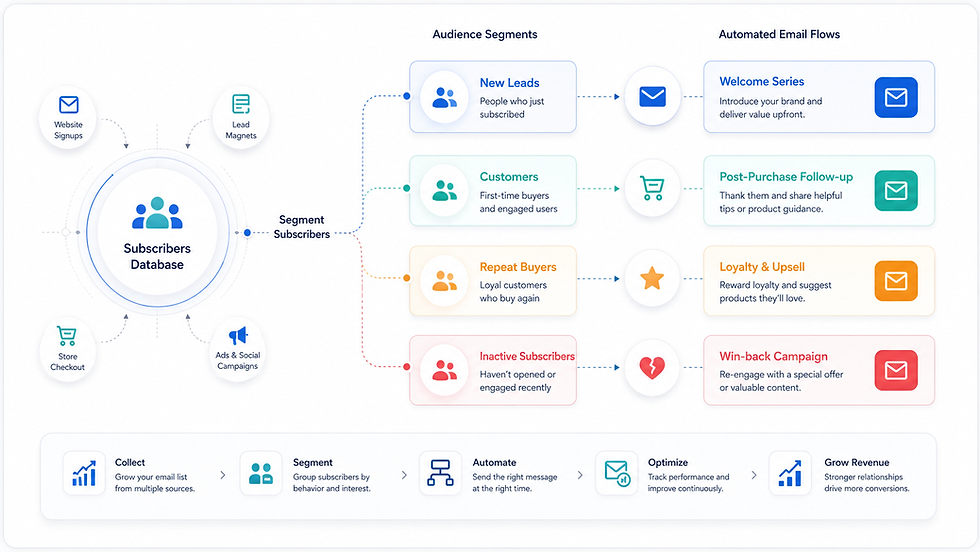
Segmentation means sending different messages to different groups. A new subscriber, a loyal customer and a lead who asked for a quote should not receive the same email. Simple ways to segment include:
Customer status: new lead, first-time buyer, repeat customer, inactive.
Interest: the product, service or topic they signed up for.
Behaviour: pages visited, links clicked, items viewed or left in the cart.
Location or language: useful in Dubai, where audiences are diverse and offers may differ by area or language.
Even two or three segments will make your emails feel more relevant and usually improve engagement.
5. Set up your core automated emails
Automation lets you send the right email at the right time without doing it manually. These are the best flows to build first:
Welcome series: two or three emails that introduce your business, share your best content and make a first offer.
Abandoned cart or abandoned enquiry: a reminder for people who started to buy or book but did not finish.
Post-purchase follow-up: a thank-you, usage tips and a request for a review.
Lead nurture: a short series that answers common questions and builds confidence before the sale.
Win-back: a message to inactive subscribers before you remove them from your list.
Once built, these flows keep working in the background and are often the most profitable part of an email program.
6. Write and design emails people want to open
Good email is clear, useful and easy to read on a phone. Focus on these basics:
Subject line: short, specific and honest. Avoid misleading or all-caps subject lines.
One main message: each email should have one goal and one clear call to action.
Helpful content first: the same principles that make web pages helpful also apply to email, as we explain in our guide on how to make SEO friendly content.
Mobile-friendly design: single-column layouts, readable fonts and buttons that are easy to tap.
Consistent branding: your logo, colours and tone should be recognisable.
Balance: mix useful content with offers. If every email is a sales pitch, people unsubscribe.
7. Send consistently and test
Choose a schedule you can keep, such as one newsletter every two weeks plus your automated flows, and stick to it. Consistency builds familiarity and trust. Send a test email to yourself first, check links and previews on mobile, and make sure your unsubscribe link works.
Once you have enough subscribers, test one thing at a time, such as subject lines, send times or button wording, and keep what works.
8. Measure results and improve
Review your numbers every month and use them to decide what to do next. The table below shows the metrics that matter most.

Metric | What it tells you | Why it matters |
Click rate | How many people clicked a link | Shows whether your content and offer are relevant |
Conversion rate | How many clicks became enquiries, bookings or sales | Connects email to real business results |
Revenue per email | Sales generated by each campaign or flow | Shows which emails earn their place |
Unsubscribe rate | How many people opted out | Warns you about too many or irrelevant emails |
Bounce rate | How many emails could not be delivered | Points to list quality and deliverability issues |
List growth | New subscribers minus unsubscribes | Shows whether your audience is growing |
Open rate | How many people opened the email | Useful as a trend, but less reliable than clicks and sales |
Open rates have become less dependable because of privacy features in some email apps, so give more weight to clicks, conversions and revenue.
What Can Email Marketing Earn Your Business? A Simple Example
Here is a simple illustration, using assumed numbers, of how one campaign could translate into revenue for an online store.
Metric | Example | How it is calculated |
Email list size | 5,000 subscribers | Assumed |
Click rate | 3 percent | Assumed |
Clicks | 150 | 3 percent of 5,000 |
Share of clicks that buy | 10 percent | Assumed |
Orders | 15 | 10 percent of 150 |
Average order value | AED 400 | Assumed |
Revenue from one campaign | AED 6,000 | 15 orders at AED 400 |
This is an illustration of the math, not a promise of results. Real numbers vary by industry, offer, list quality and how well your emails match what subscribers want. To estimate your own results, use your real order value, your realistic click and conversion rates, and your costs.
Email Marketing Tools to Consider
Tool | Best for | Why businesses choose it |
Mailchimp | Beginners and small businesses | Easy to use, with simple templates and a free plan to start |
Brevo | Small businesses on a budget | Email plus basic automation and SMS options |
ActiveCampaign | Automation-focused businesses | Strong automation and segmentation features |
Klaviyo | Ecommerce stores | Deep integration with online store data |
HubSpot | B2B and sales-led businesses | Email connected to a CRM and sales pipeline |
Features and pricing change often, so check each provider's current plans before you decide.
How Different Businesses Use Email in Dubai
Ecommerce: welcome offers, abandoned cart reminders, back-in-stock alerts and repeat purchase flows have clear, measurable revenue.
Real estate: property leads are expensive, so nurturing them with listings, market updates and viewing reminders is valuable. Our guides on how much PPC costs for real estate investors and how much real estate SEO costs show why agents and developers care about getting more from every enquiry.
Healthcare: appointment reminders, check-up recalls and patient education emails help clinics bring patients back. Understanding the wider picture, such as how to improve healthcare website rankings in Dubai and whether PPC or SEO is better for clinics in Dubai, helps you attract patients who can then join your list. Content must follow Dubai Health Authority advertising guidelines.
B2B and professional services: long sales cycles reward steady nurturing with case studies, guides and newsletters.
Education and hospitality: announcements, seasonal offers, event invitations and reminders keep audiences engaged.
A Realistic Timeline
Timeframe | Focus | What to expect |
Month 1 | Set goals, pick a platform and add sign-up forms | Foundations in place, few results yet |
Months 2 to 3 | Launch welcome email and first newsletters | First subscribers and early engagement |
Months 4 to 6 | Add abandoned cart, nurture and follow-up flows | More enquiries or repeat sales from automation |
Months 7 to 12 | Segment, test and refine based on data | Steadier results and a stronger, more engaged list |
These timelines are typical patterns, not guarantees. Progress depends on your industry, audience, offer and how consistently you send.
Rules and Compliance to Keep in Mind in the UAE
Consent: only email people who have agreed to hear from you, and make it easy to unsubscribe.
Data protection: handle subscriber data responsibly and securely, in line with UAE data protection rules.
Honest content: do not make misleading claims in subject lines or offers.
Sector rules: healthcare, real estate and financial content may have extra advertising requirements, so check current guidance from the relevant authority.
Third-party tools: know where your email platform stores data and what its privacy terms say.
Rules change, so confirm current requirements with a qualified adviser before you launch campaigns.
Common Mistakes to Avoid
Buying email lists instead of earning subscribers.
Sending only sales messages and no useful content.
Sending the same email to everyone without segmenting.
Sending too rarely, so people forget you, or too often, so they unsubscribe.
Using a design that does not work well on mobile.
Judging success by open rates alone and ignoring clicks and revenue.
Skipping consent, unsubscribe links and compliance rules.
Giving up too early, before automation and list growth have had time to work.
Frequently Asked Questions
How do I use email marketing for my business?
Set a goal, choose an email platform, build a permission-based list, segment your subscribers, set up automated emails such as a welcome series and abandoned cart reminders, send useful campaigns regularly and track clicks, conversions and revenue. Improve a little each month based on what the data shows.
Is email marketing good for small businesses?
Yes. It is affordable, you own the audience and you can start with a free plan. Small businesses often do well with email because they can build personal relationships with customers and send highly relevant messages.
How often should a business send marketing emails?
There is no single right answer. Many small businesses start with one newsletter or campaign every one to two weeks, plus automated emails. Choose a frequency you can keep up, and watch unsubscribe rates and engagement to see whether you need to adjust.
How many subscribers do I need to start?
You can start with any number. A small, engaged list of real customers and leads can generate sales, while a large list of uninterested people may not. Focus on relevance first, then grow the list.
Which email marketing tool is best for a business?
It depends on your needs. Mailchimp and Brevo are common starting points, Klaviyo suits online stores, ActiveCampaign offers strong automation and HubSpot suits businesses that want email connected to a CRM. Try a free plan or trial before choosing.
How long does it take to see results from email marketing?
Automated emails to existing customers can show results within weeks. Building a list and a steady stream of results usually takes several months, because you need subscribers, trust and enough data to improve.
Can I do email marketing myself, or should I hire an agency?
You can start yourself with a simple platform and a few core emails. An agency becomes useful when you want strategy, automation, design and reporting handled professionally, or when you want email to work together with search, paid ads and social media.
Is email marketing legal in the UAE?
Yes, when done properly. You need clear consent, an easy way to unsubscribe and responsible handling of personal data. Rules can change, so confirm current requirements before you launch campaigns.
Final Thoughts
So, how do you use email marketing for business? Start with a clear goal, build a list of people who genuinely want to hear from you, automate the essential emails, send helpful content consistently and let the data guide your improvements. Email rewards patience and relevance, and it gives you an audience that you own.
If you want email to work alongside search, paid ads and social media, contact the Slicky Media team for a clear plan that fits your goals and your audience in Dubai.


